Leetcode 491.非递减子序列
题目要求
示例 1:
输入:nums = [4,6,7,7]
输出:[[4,6],[4,6,7],[4,6,7,7],[4,7],[4,7,7],[6,7],[6,7,7],[7,7]]
示例 2:
输入:nums = [4,4,3,2,1]
输出:[[4,4]]
回溯法
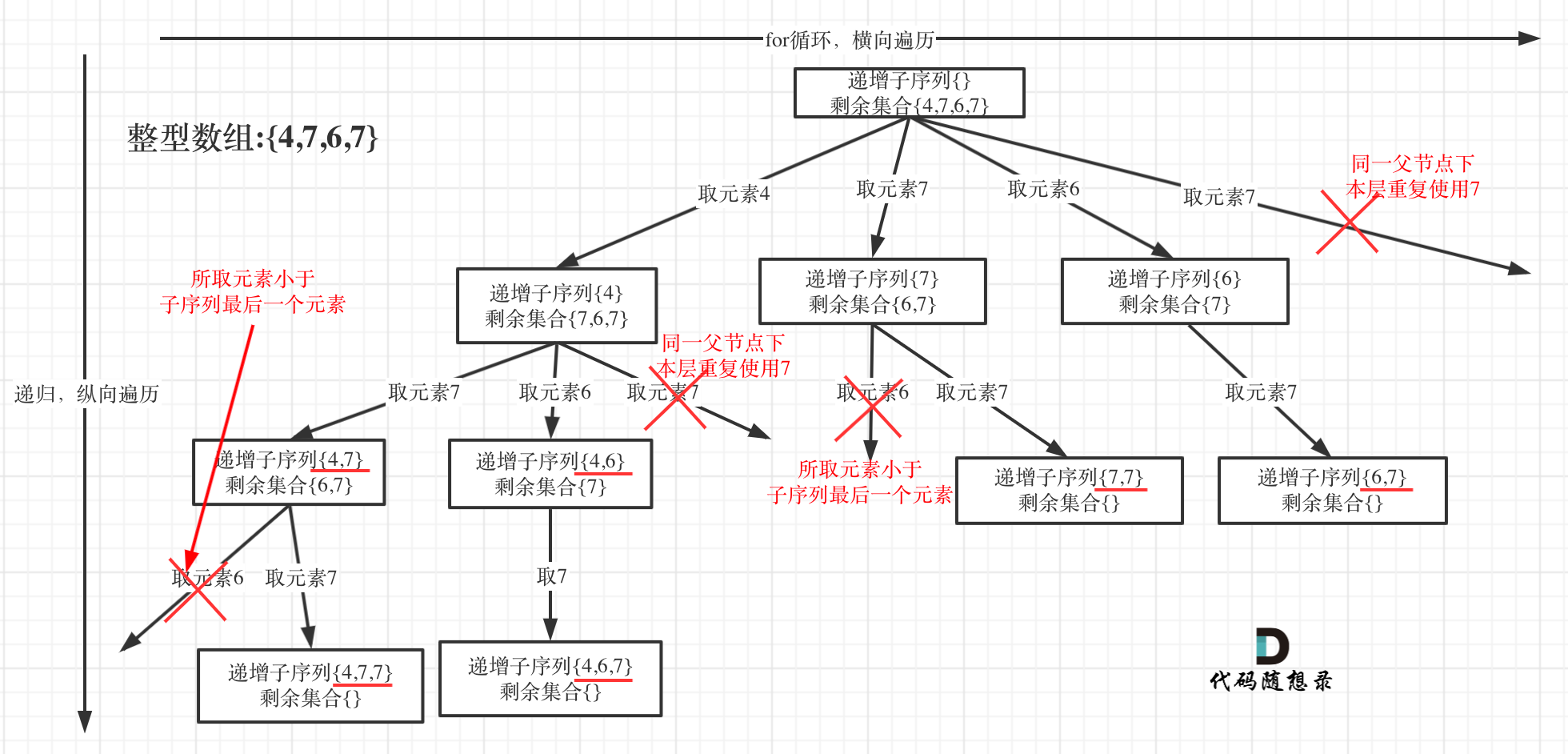
树层去重在for循环内设置终止条件
set用于判断该层是否用过该元素,用于去重
1
2
3
4
5
6
7
8
9
10
11
12
13
14
15
16
17
18
19
20
21
22
23
24
25
26
27
28
| class Solution {
public List<List<Integer>> res = new ArrayList<List<Integer>>();
public List<Integer> path = new ArrayList<>();
public List<List<Integer>> findSubsequences(int[] nums) {
backtrack(nums, 0);
return res;
}
public void backtrack(int[] nums, int startIndex) {
if (path.size() > 1) {
res.add(new ArrayList<>(path));
}
Set<Integer> set = new HashSet<>();
for (int i = startIndex; i < nums.length; i++) {
if (!path.isEmpty() && nums[i] < path.get(path.size() - 1)) {
continue;
}
if (set.contains(nums[i])) {
continue;
}
path.add(nums[i]);
set.add(nums[i]);
backtrack(nums, i + 1);
path.remove(path.size() - 1);
}
}
}
|
代码随想录:使用map
1
2
3
4
5
6
7
8
9
10
11
12
13
14
15
16
17
18
19
20
21
22
23
24
25
26
27
28
29
30
| class Solution {
List<List<Integer>> res = new ArrayList<>();
LinkedList<Integer> path = new LinkedList<>();
public List<List<Integer>> findSubsequences(int[] nums) {
getSubsequences(nums,0);
return res;
}
private void getSubsequences( int[] nums, int start ) {
if(path.size()>1 ){
res.add( new ArrayList<>(path) );
}
HashMap<Integer,Integer> map = new HashMap<>();
for(int i=start ;i < nums.length ;i++){
if(!path.isEmpty() && nums[i]< path.getLast()){
continue;
}
if ( map.getOrDefault( nums[i],0 ) >=1 ){
continue;
}
map.put(nums[i],map.getOrDefault( nums[i],0 )+1);
path.add( nums[i] );
getSubsequences( nums,i+1 );
path.removeLast();
}
}
}
|